


Introduction
Origin
The establishment of the Institute of Strategic and International Affairs (ISIA) at National Chung Cheng University was driven by the growing demand for professionals in strategy, national defense, diplomacy, cross-strait relations, and national security amid rapid globalization and shifts in the international political landscape. Following the transformation of the international system after the Cold War, along with the increasing complexity of regional conflicts and non-traditional security issues, international affairs have expanded beyond traditional diplomacy to encompass interconnected economic, security, technological, and social dimensions.
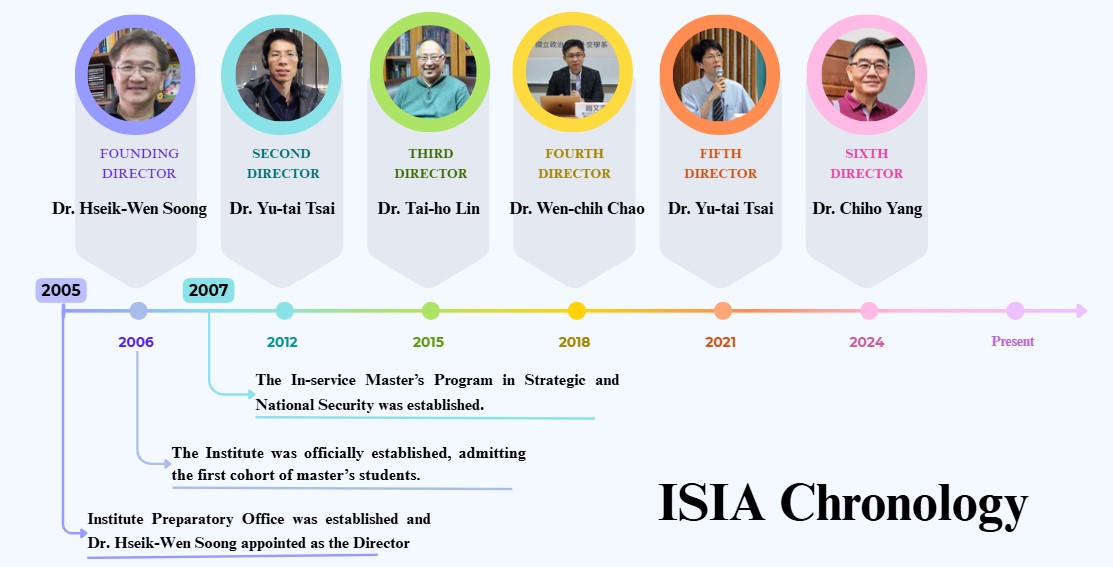
In response, and in alignment with the University’s vision of becoming a first-class comprehensive university with an international perspective, the University established a preparatory office in 2005. Professor Hseik-wen Soong was appointed as its director to oversee and advance the establishment of the Institute, addressing the longstanding lack of specialized institutions for strategic and international affairs studies in central and southern Taiwan.
Mission
The Institute was officially established on August 1, 2006, admitting its first cohort of eight master’s students and commencing its teaching and research activities. Its establishment filled a gap in professional education in strategy and international affairs in central and southern Taiwan, while undertaking the mission of cultivating professionals with global perspectives, policy analysis skills, and practical experience. In its early stage, the Institute focused on training talents grounded in international relations theory and strategic analysis, gradually developing its curriculum and research directions.
To strengthen connections with practice, the Institute launched the In-service Master’s Program in Strategic and National Security in 2007. This program enrolls in-service personnel from government agencies and related institutions, promotes the integration of academic research and policy practice, and enhances interaction between academia and government, thereby expanding the Institute’s social impact.
Through sustained efforts under successive directors, the Institute has gradually become an important academic base for strategic and international affairs studies in Taiwan, with notable achievements in teaching, research, and policy engagement.
In terms of organizational development, the Institute has been led by successive directors as follows:
Professor Hseik-wen Soong (2005–2012, Director of the Preparatory Office and founding Director);
Professor Yu-tai Tsai (2012–2015, second Director);
Associate Professor Tai-ho Lin (2015–2018, third Director);
Professor Wen-chih Chao (2018–2021, fourth Director);
Professor Yu-tai Tsai (2021–2024, fifth Director);
and the current Director, Associate Professor Chiho Yang (2024–present).
Each director has contributed to the Institute’s development by enhancing the curriculum, strengthening research capacity, expanding external collaboration, and increasing academic influence, guiding the Institute toward greater institutionalization and professionalization.
Since its establishment, with support from both within and beyond the University, the Institute has continuously advanced its teaching and research, actively engaged in domestic and international academic exchanges and policy dialogue, and developed into a key academic hub for strategic and international affairs in central and southern Taiwan. Looking ahead, the Institute will continue to build on this foundation, advancing internationalization, interdisciplinarity, and practice-oriented development in response to evolving global and regional challenges.
Structure
The academic development of the Institute is grounded in the principles of interdisciplinary integration and the balanced emphasis on theory and practice, aiming to cultivate professionals equipped with a solid foundation in international relations, policy analysis, and strategic thinking.
In terms of academic positioning, Strategic and International Affairs Studies is an emerging interdisciplinary field spanning political science, economics, sociology, and management. It addresses key issues such as global governance, international security, regional strategy, national development, and public policy. Accordingly, the Institute has established a comprehensive teaching and research framework comprising three core fields:
Field A: International Relations and International Affairs
This field focuses on international relations theory, international organizations, global governance, international political economy, and human security, fostering students’ understanding of the global system.
Field B: Asia-Pacific Security and Strategy
This field examines regional security dynamics, cross-strait relations, national defense policy, U.S.–China strategic developments, and geopolitical changes in the Asia-Pacific, strengthening students’ strategic perspectives on security issues.
Field C: Policy Science and Strategic Management
This field emphasizes policy analysis, strategic planning, and decision-making, complemented by training in negotiation, communication, and crisis management.
The curriculum is anchored by three required core courses—International Relations Theory, Social Science Methodology, and Strategic Planning and Problem Solving—which provide the foundation for academic training. These are complemented by a range of elective courses, including Strategic Studies, International Political Economy, International Organizations, Culture and Strategy, Globalization and Global Governance, Human Rights and Human Security, Communication, Negotiation and Conflict Management, Terrorism Studies, Cross-Straits Economic and Trade Relations and Taiwan Development, WTO and International Security, Chinese Politics, Economy and Strategic Studies, U.S. Foreign Policy, Asia-Pacific Strategic Situation Analysis, Public International Law, Modern Diplomatic History, and Taiwan’s International Relations History.
The curriculum follows a progressive structure: the first year emphasizes theoretical and methodological training, while the second year focuses on case studies and thesis research, cultivating students’ independent research and policy analysis capabilities.
In addition, the Institute actively collaborates with government agencies and related sectors—such as diplomacy, national defense, national security, police administration, and the coast guard—to provide students with practical training and opportunities to engage in policy discussions, further strengthening the integration of theory and practice.
Vision
Since its establishment, the Institute of Strategic and International Affairs at National Chung Cheng University has upheld its mission of cultivating professionals with international perspectives, strategic thinking, and a strong sense of public responsibility, while serving as a key platform linking academic research and policy practice.
The Institute’s faculty bring expertise in international relations theory, regional studies, national security, foreign policy, and international political economy. With extensive experience in both academia and policy engagement, they provide a learning environment that balances depth and breadth. In addition to academic training, the Institute emphasizes ethical awareness, social responsibility, and communication and coordination skills, fostering professionals with strong adaptability and interdisciplinary competence. The integration of the regular master’s program and the in-service program further enables students to connect theoretical knowledge with practical experience.
Over the years, the Institute has developed into a leading center for education and research in strategic and international affairs in central and southern Taiwan. Its graduates serve in government agencies, national security institutions, diplomatic services, research organizations, and the private sector, reflecting the Institute’s impact on talent cultivation. Looking ahead, the Institute will continue to advance interdisciplinary research, strengthen international collaboration and policy engagement, and respond to evolving global and national challenges, with the aim of cultivating strategic professionals equipped with analytical capacity, sound judgment, and practical competence.